Honda Lawn Mower Transmission Repair: Diagnosis and Replacement Options
Most Honda lawn mower transmission problems come from a loose or damaged drive belt, worn cable, stuck drive lever, or a damaged gearbox. You can diagnose the problem at home, but a sealed or broken transmission usually makes replacement more sensible than an internal rebuild.
Is the mower engine running while the wheels barely move? Does the drive work on flat grass but quit when the lawn gets thick, wet, or slightly uphill? A mower that suddenly becomes hard to push backward can point to a different problem than a mower that simply loses forward drive.
I once chased a “bad transmission” that turned out to be a belt packed with grass clippings and oil. The belt looked fine from above, but it slipped like a wet shoelace under load, and I wasted an afternoon before checking the simple stuff. That mistake is common, not dumb.
I wrote this guide for Honda owners who want a straight answer before buying parts or handing the mower to a shop. You’ll get a practical way to test the self-propel system, replace the parts that commonly fail, and decide when the repair has crossed the line into false economy.
Get the diagnosis right, and you can restore smooth drive, avoid replacing a good gearbox, and keep a small problem from chewing up a belt or pulley. Skip the checks, and you may spend money on a transmission when a cable adjustment would have solved the whole mess.
This takes about 9 minutes, and you’ll learn how to:
- Test the drive system without guessing at parts.
- Tell a belt, cable, pulley, axle, and gearbox problem apart.
- Replace a worn belt safely on common Honda walk-behind mowers.
- Decide between repair, transmission replacement, and a new mower.
How to Repair Honda Lawn Mower Transmission
To repair a Honda lawn mower transmission, first test the drive cable and belt, then inspect the pulleys, axle, and gearbox before replacing anything. A slipping belt or stretched cable is usually a manageable repair, while grinding, leaking, or seized gears often calls for a complete transmission replacement.
Honda mower designs vary by model, so start by recording the model code from the mower deck or rear housing. Common families include the HRR, HRX, and HRS lines, and the drive layout can differ between front-wheel drive, rear-wheel drive, and hydrostatic systems.
Use this order of diagnosis:
- Stop the engine, disconnect the spark plug wire, and remove the ignition key if the model has one. Wait for the blade to stop completely before touching the underside.
- Check the drive control cable. Squeeze the self-propel lever and watch the cable movement near the transmission or drive arm.
- Inspect the drive belt. Look for cracks, shiny glazed areas, missing chunks, frayed edges, oil, or a belt that hangs loose.
- Check the drive pulley and idler. A pulley should turn smoothly without wobbling, scraping, or binding.
- Lift the drive wheels and turn them by hand. Both wheels should move smoothly in the drive direction, with no crunching or harsh resistance.
- Test the transmission input. With the spark plug wire still disconnected, rotate the drive pulley or input shaft by hand if the design allows it.
- Reassemble and test on dry, level grass. Use the lowest drive speed first, then test under a light load.
A mower that moves when the wheels are lifted but stops on grass often has a slipping belt, weak spring, worn pulley, or stretched cable. A mower that refuses to move even with a tight belt may have a seized axle, damaged gear, or failed transmission.
A quick cable test saves a lot of wasted effort. When you squeeze the drive lever, the cable should pull the transmission arm through its full range; if the lever reaches the handle with little resistance, the cable may be stretched or the control bracket may be bent.
What The Symptoms Usually Mean
The table below helps separate a simple control problem from a serious gearbox fault.
| Symptom | Most likely cause | First check | Usual repair |
|---|---|---|---|
| Engine runs, wheels do not turn | Loose belt, stretched cable, broken pulley | Belt tension and cable movement | Adjust cable or replace belt |
| Drive works briefly, then slips | Glazed belt, oil contamination, weak idler spring | Belt surface and spring | Clean pulley and replace belt if needed |
| One wheel turns, one wheel drags | Worn wheel gear, axle issue, drive pawl | Wheel rotation and gear teeth | Replace wheel or axle part |
| Grinding or clicking under load | Damaged gearbox or stripped gear | Gearbox noise and input shaft | Replace transmission assembly |
| Mower is hard to pull backward | Wheel lock, pawl, axle binding, drive engagement | Rear wheels and drive arm | Free the mechanism or replace worn parts |
| Drive lever feels loose | Stretched cable or broken cable end | Cable housing and anchor | Adjust or replace cable |
| Drive works only on smooth ground | Weak belt tension or worn traction parts | Belt, idler, and wheel tread | Replace worn drive components |
If your Honda HRR216 is hard to pull backward, don’t jump straight to a failed transmission. A locked rear wheel, engaged drive pawl, bent linkage, or axle packed with debris can create that exact complaint, and the fix may be far smaller than a gearbox replacement. Honda HRR216 reverse diagnosis gives that symptom its own focused check.
Pro Tip: Take a phone photo of the belt path before removing the old belt. A blurry picture is still better than guessing around a pulley after the mower is apart.
Belt, Cable, and Transmission Repairs
Most Honda self-propel repairs begin with the belt and cable because those parts transfer control from your hand to the transmission. Replace the belt only after confirming the belt is actually slipping, damaged, contaminated, or stretched beyond the available adjustment.
Before working under the deck, drain the fuel into an approved container if the mower must be tilted and follow the model’s correct tilt direction. Disconnect the spark plug wire and keep the wire away from the plug, because a small engine can start from an accidental blade movement.
A drive belt transfers engine or pulley power to the transmission. A belt can look intact and still fail when the mower meets thick grass, because heat and load polish the rubber until the belt slides instead of gripping.
Replace the belt when you find:
- Cracks across the ribs or sidewall.
- Frayed edges or missing belt material.
- A shiny, glassy surface.
- Oil, fuel, or heavy grass residue that won’t clean away.
- A belt that remains loose after correct cable adjustment.
- A belt that repeatedly jumps off the pulley.
A cable adjustment may solve the problem if the belt is healthy and the transmission arm does not reach its full engagement position. Make small adjustments, then test the lever travel and wheel response; too much tension can keep the drive engaged when you release the handle.
For a belt replacement, the broad process is:
- Disconnect the spark plug wire and secure the mower.
- Remove the belt cover or underside shield as the model requires.
- Photograph the routing and note the belt size or part number.
- Release the belt tension carefully at the idler or transmission pulley.
- Remove the old belt from the engine pulley and transmission pulley.
- Clean grass, oil, and packed dirt from the pulley grooves.
- Install the new belt along the original route, with no twists.
- Refit the cover, reconnect the spark plug wire, and test the drive slowly.
If you need the full removal sequence for a common Honda self-propel layout, Honda mower belt replacement covers the belt-specific job without mixing it up with an internal transmission repair.
The belt should sit fully inside the pulley groove, not ride on the edge. A belt that looks correct but climbs out of the groove during operation usually points to a bent pulley, incorrect belt size, worn bearing, or misrouted belt.
When The Gearbox Is Really Bad
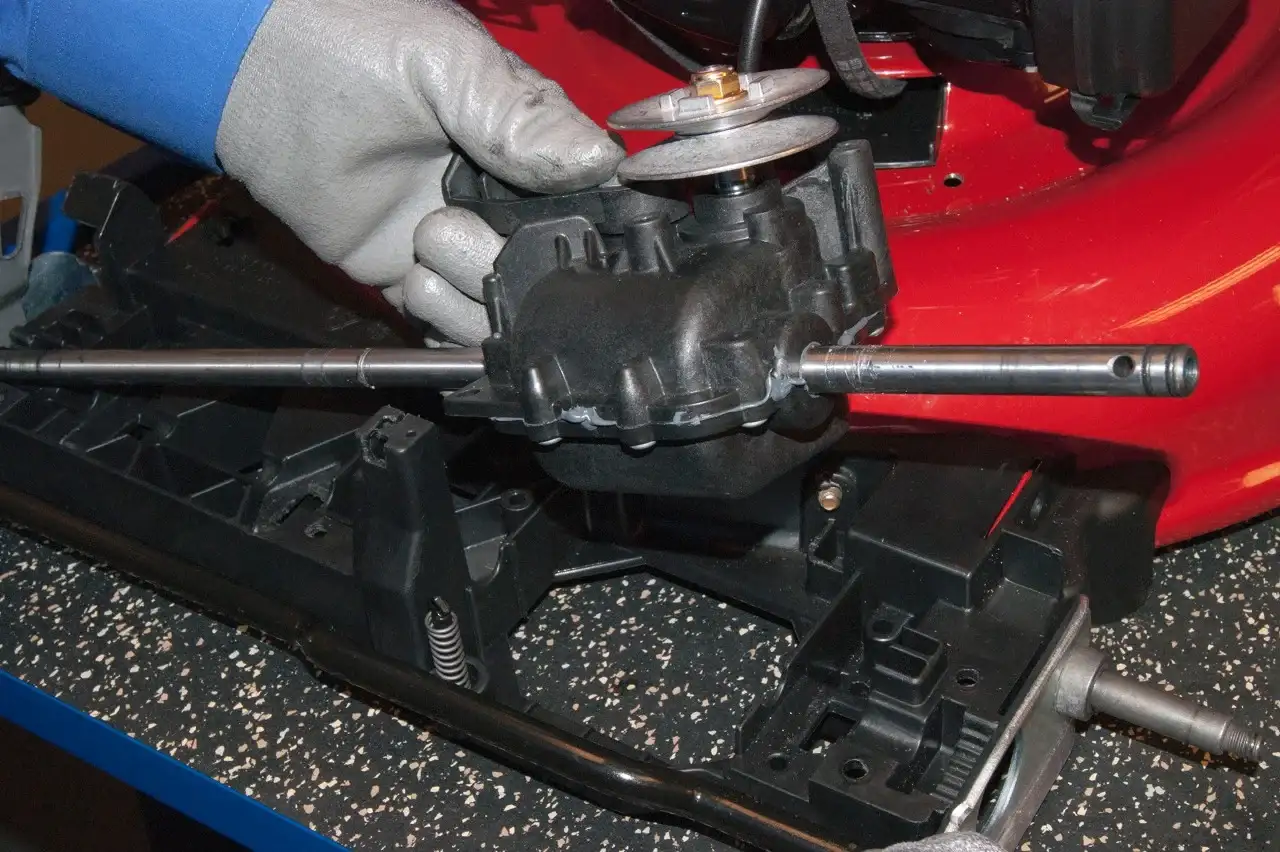
A Honda mower transmission is likely damaged when the input pulley turns but the output axle does not, or when the gearbox grinds, binds, leaks, or has stripped internal gears.
With the engine off and the spark plug wire disconnected, rotate the input pulley by hand. The drive axle should respond through the transmission, though some designs may show limited movement because of a differential or freewheel mechanism.
Grinding deserves attention because metal-on-metal noise usually means the damage is inside the gearbox, the enclosed assembly that transfers pulley rotation to the wheels. Don’t keep mowing to “test it” if the housing is cracked or the gears lock up, since a seized drive can damage the belt, pulley, or axle.
I once opened a drive housing expecting a single broken gear and found a thick paste of dirt and old grease around the moving parts. The contamination had made the mechanism bind, and a careful cleaning plus the correct lubricant restored movement; the lesson was simple, check for dirt and free movement before condemning expensive parts.
Some Honda transmissions are not designed for practical internal rebuilding. If the case is riveted, parts are unavailable, or the axle and gears show heavy wear, replacing the complete assembly is usually cleaner and faster than trying to press in individual gears.
Replacement Versus Repair
A replacement transmission must match the mower model, drive layout, axle shape, pulley position, and wheel connection. Two Honda mowers can look nearly identical while using different drive assemblies, so match the model code and parts diagram before ordering.
| Repair choice | Best fit | Skill level | Main risk |
|---|---|---|---|
| Cable adjustment | Drive engages late or weakly, belt looks good | Low | Over-tightening the cable |
| Belt replacement | Belt slips, cracks, or jumps off | Moderate | Wrong routing or belt size |
| Pulley or idler repair | Wobble, scraping, weak tension | Moderate | Missing spacer or washer |
| Wheel or axle part | One wheel drags or skips | Moderate | Hidden axle damage |
| Complete transmission | Grinding, seized gears, cracked housing | Moderate to high | Wrong assembly |
| Professional repair | Severe corrosion or uncertain teardown | Varies | Labor may exceed mower value |
Would I rebuild a sealed Honda transmission at home? Usually not. I’d rather spend that effort on a correct replacement assembly, because a gearbox that goes back together slightly out of alignment can fail again before the next mowing season.
The repair makes more sense when the deck is solid, the engine starts easily, the wheels and handles are in good shape, and the mower only needs a belt or cable. A replacement mower starts to make more sense when several major parts are worn at once, especially the engine, deck, drive system, and wheels.
Testing, Safety, and Long-Term Fixes
A safe transmission repair depends on preventing accidental engine starts, keeping fuel away from hot parts, and testing the repaired drive without placing your hands near the blade.
Use these precautions before any underside work:
- Disconnect the spark plug wire before touching the blade area.
- Remove the battery connector on electric-start models when practical.
- Let the engine cool before working near the muffler or fuel tank.
- Wear gloves when handling sharp deck edges, but keep gloves away from rotating parts.
- Support a tilted mower securely instead of balancing it on a flimsy object.
- Never test the drive with the mower raised unless the support is stable and your hands stay clear.
- Keep children and pets away during the repair and test run.
A short test on pavement can make a weak drive seem better than it is, because the wheels need little traction. Dry grass gives a more honest result, but begin on level ground and keep the blade disengaged when the mower design allows it.
After the repair, check four things: smooth engagement, full release, equal wheel movement, and belt tracking. The mower should stop pulling when you release the drive lever; if it keeps creeping, shut it off and correct the cable before mowing.
Fixes That Prevent Repeat Failures
Grass buildup traps moisture and heat around the belt and pulleys. Clean the underside after the mower cools, especially near the transmission cover, because a packed layer can hold the drive arm partly engaged.
Avoid forcing the mower backward while the drive is engaged. Release the drive lever fully, allow the wheels to stop, then pull the mower back; forcing the wheels can stress pawls, wheel gears, and the transmission axle.
Use the correct lubricant only where the model calls for lubrication. Spraying random oil onto a belt creates more slipping, and thick grease in a mechanism meant for light oil can make cold operation stiff.
Important Tip: Don’t wash a mower by blasting water into the transmission cover, wheel hubs, cable ends, or pulley bearings. A brush, plastic scraper, and damp cloth remove grass with far less trouble.
A cable that keeps losing adjustment may have a cracked housing, weak anchor, or bent control bracket. Replacing only the cable can leave the real fault untouched, so watch the cable housing while squeezing the lever and confirm that the housing stays fixed.
Is Repair Worth The Money?
Repairing a Honda mower is often worth the money when the engine has good compression, starts without a fight, and the deck has no serious rust-through. A belt, cable, wheel, or pulley repair can extend a sound mower’s useful life for years.
The decision changes when the mower has a failing engine, a cracked deck, damaged controls, and a bad transmission at the same time. Honda mower repair value can help you weigh repair cost against replacement when several worn parts are piling up.
Use this quick decision test:
- Repair first: One failed drive part, good engine, solid deck.
- Compare quotes: Complete transmission failure with moderate deck and engine wear.
- Replace the mower: Multiple major systems failed, severe deck corrosion, or repeated repair trouble.
- Call a professional: Transmission teardown requires special tools, or the mower has fuel, electrical, or engine problems beyond your comfort level.
I’d spend money on a good belt and careful diagnosis before shopping for a new mower. I wouldn’t pour a large repair bill into a machine that also burns oil, shakes badly, and has a deck thin enough to flex under your hand.
FAQs About How to Repair Honda Lawn Mower Transmission
Can a Honda lawn mower transmission be repaired?
Yes, a Honda lawn mower transmission can sometimes be repaired with a belt, cable, pulley, wheel, axle, or external linkage. A sealed gearbox with stripped gears, cracked housing, or severe bearing damage usually makes complete transmission replacement more practical than internal repair.
Why does my Honda self-propel mower move slowly?
A Honda self-propel mower may move slowly because of a slipping drive belt, stretched cable, weak idler spring, worn wheel gear, or heavy grass buildup. Check belt condition, cable travel, pulley tension, and wheel engagement before adjusting the engine or replacing the transmission.
Why is my Honda mower hard to pull backward?
A Honda mower can be hard to pull backward when the drive mechanism remains partly engaged, a wheel pawl locks, an axle binds, or debris blocks the rear wheel assembly. Release the drive lever, lift each wheel safely, and check for equal free movement before testing the gearbox.
How do I know if my Honda mower belt is bad?
A Honda mower belt is bad when the belt has cracks, shiny glazing, frayed edges, missing material, oil contamination, or repeated slipping under load. A belt that looks whole can still fail if it stretches enough to lose tension, so compare its slack with the model’s adjustment range.
Can I replace a Honda lawn mower transmission myself?
Yes, a mechanically confident owner can replace a Honda lawn mower transmission with hand tools, careful photos, and the exact model-specific assembly. The job becomes less suitable for home repair when fasteners are seized, the axle is bent, or the drive housing requires pressing bearings or gears.
How long should a Honda mower transmission last?
A Honda mower transmission can last many seasons when the belt stays clean, the drive is released before pulling backward, and grass buildup is removed. Service life depends on mowing hours, hills, soil, storage, maintenance, and whether the mower is repeatedly forced through heavy wet grass.
The Smartest Next Step for Your Honda Mower
Honda lawn mower transmission repair starts with a calm diagnosis, not a parts order. Check the cable, belt, pulley, wheel movement, and transmission input in that order, because the cheapest failed part is often the one hiding in plain sight.
My practical choice is to repair a sound mower when the fault is external and the deck and engine remain healthy. If the gearbox is damaged along with major engine or deck problems, compare the full repair cost with a replacement mower before spending another dollar.
Start with the model code, disconnect the spark plug wire, and inspect the drive belt and cable today. That first ten-minute check can turn a frustrating transmission mystery into a small, clean repair.