Honda Commercial Mower vs Residential: Models and Differences
Honda commercial mowers are built for frequent, demanding work, while Honda residential mowers prioritize home-lawn convenience and value. In Honda’s walk-behind lineup, the HRC series is commercial grade; the HRN is a standard residential option, and the HRX is a premium residential option. A commercial mower is not automatically the best mower for every yard.
One important update changes this comparison. Honda stopped producing its U.S. gas-powered HRN, HRX, and HRC walk-behind mowers in 2023, then introduced battery-powered replacements for sale beginning in November 2025. Older gas machines, including the commercial HRC216 and residential HRN216 and HRX217, are still relevant for used buyers and owners, but should not be mistaken for current-production gas models.
The newer HRC-BE adds a stronger motor, reinforced construction, and commercial-oriented controls. Residential HRX models offer useful features such as versatile mulching and leaf shredding, sometimes at a considerably lower price.
In this article, I compare Honda commercial mower vs residential designs across engines and motors, decks, cutting quality, drive systems, batteries, warranties, maintenance, and costs. I also explain how the older gasoline models differ from the current battery lineup and which type makes sense for homeowners, large properties, and professional mowing businesses.
Honda Commercial Mower vs Residential: Key Differences
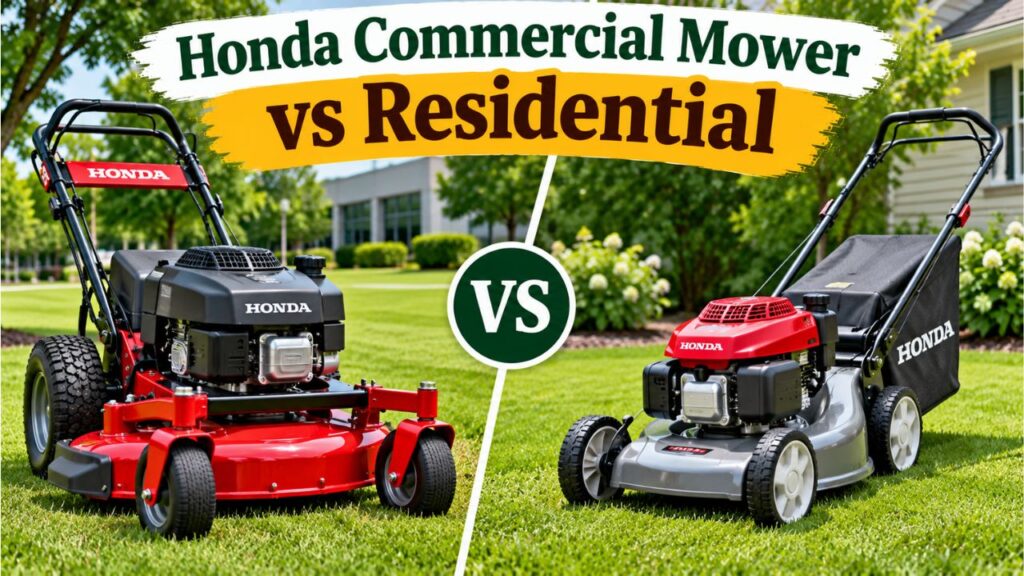
The biggest difference is intended workload. Honda’s HRC commercial mowers are designed for landscaping professionals who operate equipment frequently, while HRN and HRX residential mowers are primarily designed for homeowners.
Commercial models generally prioritize reinforced components and durability under sustained use.
Residential models focus more on ease of operation, storage convenience, versatile cutting features, and purchase price.
Honda Commercial vs Residential Mower Comparison
| Feature | Honda commercial mower (HRC) | Honda residential mower (HRN/HRX) |
| Primary purpose | Professional lawn maintenance | Home lawn care |
| Intended workload | Frequent and demanding operation | Typical weekly or seasonal mowing |
| Construction | Reinforced commercial components | Standard or premium residential construction |
| Current power source | Battery-powered HRC-BE | Battery-powered HRN and HRX |
| Older gasoline engines | Commercial GSV160 or GXV160, depending on model | GCV170 or GCV200, depending on model |
| Deck materials | Reinforced steel | Steel or NeXite composite |
| Drive system | Commercial-oriented self-propel system on powered models | Smart Drive, Select Drive, or eSelect Drive |
| Cutting features | Primarily mulching and bagging | Mulching, bagging, discharge, and sometimes leaf shredding |
| Cutting width | Commonly 21 inches | Commonly 21 inches |
| Weight | Generally heavier | Usually lighter |
| Maintenance | Designed for frequent service and inspection | Intended for regular homeowner maintenance |
| Warranty | Commercial-use coverage on HRC models | Commercial coverage often much shorter |
| Purchase cost | Higher | Lower to moderate |
| Best suited for | Landscapers and frequent mowing | Most homeowners |
These are general series differences, not guarantees about every historical model.
According to Honda Power Equipment’s lawn mower selection guide, the HRN and HRX series are intended for residential mowing, while the HRC series includes reinforced components for commercial applications.
Which Honda Mower Is Better?
For most homeowners, an HRN or HRX provides enough performance without the extra cost of a commercial mower.
For professional landscaping, frequent mowing, and prolonged daily operation, the HRC’s heavier-duty construction can justify the investment.
However, a premium residential HRX may offer more cutting features than an HRC.
Key Takeaway: Commercial does not mean every specification is better. It means the mower is designed around a different pattern of use.
Are Honda Commercial and Residential Gas Mowers Still Made?
This is important when comparing Honda mower models.
Honda discontinued production of its U.S. gas-powered HRN, HRX, and HRC walk-behind lawn mowers in 2023.
The company introduced battery-powered replacements, which began going on sale at selected U.S. dealers in November 2025.
According to Honda’s official October 2025 announcement, the battery lineup consists of:
- HRN-BV — residential
- HRX-BV — premium residential
- HRX-BE — premium residential
- HRC-BE — commercial
Older gasoline Honda mowers may still be available secondhand or through remaining inventory, but they are not the current-production U.S. walk-behind gasoline lineup.
This matters because the engines, drive systems, batteries, warranties, and prices differ between generations.
The following sections compare the current battery models first, then the older gasoline models separately.
Honda HRC vs HRX vs HRN: Current Battery Mower Comparison
Honda’s battery-powered lineup provides a useful side-by-side comparison of commercial and residential mower design.
All four models use 21-inch cutting decks and Honda’s MicroCut twin-blade system.
However, the motors, construction, controls, battery arrangements, and cutting functions differ.
Honda Battery Mower Specifications
| Specification | HRN-BV | HRX-BV | HRX-BE | HRC-BE |
| Classification | Residential | Premium residential | Premium residential | Commercial |
| Rated motor power | 1.5 kW | 1.5 kW | 1.5 kW | 2.0 kW |
| Deck material | Steel | NeXite | NeXite | Reinforced steel |
| Cutting width | 21 in. | 21 in. | 21 in. | 21 in. |
| Drive control | Smart Drive | Select Drive | eSelect Drive | Electronic Cruise Control |
| Battery bays | 1 | 1 | 2 | 2 |
| Included battery | 8 Ah | 8 Ah | 12 Ah | 12 Ah |
| Rated runtime with included battery | Up to 30 min. | Up to 30 min. | Up to 45 min. | Up to 45 min. |
| Cutting modes | Mulch, bag, discharge | Mulch, bag, discharge, leaf shred | Mulch, bag, discharge, leaf shred | Mulch, bag |
| Blade-stop feature | No separate Roto-Stop | No separate Roto-Stop | Yes | Yes |
| Published U.S. MSRP | $899 | $1,049 | $1,299 | $1,999 |
Specifications and manufacturer-suggested retail prices are from Honda’s U.S. model information. Actual prices and availability vary by dealer, and runtime depends on operating conditions.
Honda HRN-BV: Standard Residential Model
The HRN-BV is designed for homeowners who need reliable self-propelled mowing without premium commercial features.
Its main features include:
- 1.5 kW brushless motor
- 21-inch steel deck
- Variable-speed Smart Drive
- Three cutting modes
- Single battery bay
- Included 8 Ah battery
- Folding handle
Honda estimates up to 30 minutes of runtime with its included battery under suitable conditions.
The HRN-BV is a practical choice for smaller or medium residential lawns where mowing convenience and purchase price matter most.
Honda HRX-BV: Premium Residential Model
The HRX-BV adds several features.
These include:
- NeXite composite deck
- Variable-speed Select Drive
- Four-in-one Versamow cutting system
- Leaf shredding
- Adjustable mulching and bagging
- Folding handle
Its 1.5 kW motor is rated similarly to the HRN-BV’s motor.
The main advantage is not a substantial increase in rated motor power.
Instead, it offers greater cutting versatility and premium control features.
Honda HRX-BE: Premium Residential With Dual Batteries
The HRX-BE adds electronic drive control and two battery bays.
It includes:
- 1.5 kW brushless motor
- eSelect Drive
- NeXite deck
- Roto-Stop blade-stop feature
- Two battery bays
- Included 12 Ah battery
- Four-in-one cutting capability
Honda estimates up to 45 minutes of runtime with the included 12 Ah battery.
A second compatible battery can extend operation.
This makes the HRX-BE attractive to homeowners with larger lawns or those who prefer more convenience and flexibility.
Honda HRC-BE: Commercial Battery Mower
The HRC-BE is specifically designed for professional mowing.
It includes:
- 2.0 kW brushless motor
- Reinforced 21-inch steel deck
- Front bumper and deck guards
- Heavy-duty handles and supports
- Electronic Cruise Control
- Roto-Stop blade-stop system
- Two battery bays
- Included 12 Ah battery
- Commercial-oriented construction
Its rated motor output is approximately 33% greater than the 1.5 kW residential models.
However, this does not guarantee 33% faster mowing or 33% longer battery life.
The commercial advantage involves power capability, construction, and suitability for more demanding work.
Honda Commercial vs Residential Gas Mowers: Engine Differences
Honda’s older gasoline mowers remain popular in the used equipment market.
The engine differences are among the most significant distinctions between commercial and residential models.
Honda Commercial GXV160 vs Residential GCV Engines
| Specification | Honda HRC216 commercial | Honda HRN216 residential | Honda HRX217 residential |
| Example engine | GXV160 | GCV170 | GCV200 |
| Engine category | Commercial-grade | Residential-grade | Premium residential |
| Engine displacement | 163 cc | 167 cc | 201 cc |
| General design | OHV | OHC | OHC |
| Typical cutting width | 21 inches | 21 inches | 21 inches |
| Deck material | Heavy-duty steel | Steel | NeXite composite |
| Drive options | Push or hydrostatic, depending on model | Push or belt-driven self-propel | Belt-driven self-propel or hydrostatic |
| Intended use | Professional mowing | Residential lawn care | Premium residential mowing |
Specifications vary across model generations and variants. The push-type HRC216PDA, for example, uses Honda’s GSV160 engine rather than the GXV160 found in certain self-propelled HRC216 models.
What Makes the GXV160 Commercial Grade?
Honda designed the GXV160 for demanding equipment applications.
On HRC216 commercial mowers, notable engine features include:
- Cast-iron cylinder sleeve
- Dual-element air cleaner
- Ball-bearing-supported crankshaft
- Mechanical governor
- Manual throttle control
- Service-oriented engine design
These features are intended to support durability and reliability under frequent use.
The dual-element air cleaner is particularly useful in dusty mowing conditions because it provides additional filtration.
According to Honda’s HRC216HDA specifications, the GXV160 includes a cast-iron cylinder sleeve and a two-stage air filtration system.
Is the GCV200 More Powerful Than the GXV160?
The GCV200 has greater displacement than the GXV160.
However, displacement alone does not determine which engine is better for a particular workload.
Engine design, torque characteristics, cooling, lubrication, and intended duty also matter.
The GCV200 was designed to provide strong performance in Honda’s premium residential HRX mowers.
The GXV160 was designed around commercial reliability.
Therefore, a larger residential engine is not automatically a better commercial engine.
Which Gas Engine Lasts Longer?
A well-maintained commercial engine is designed to withstand demanding use.
However, there is no reliable universal operating-hour figure that guarantees a GXV160 will outlast every GCV170 or GCV200.
Actual service life depends on:
- Maintenance
- Oil condition
- Air filtration
- Engine operating load
- Dust exposure
- Storage conditions
- Fuel quality
- Repair history
A neglected commercial engine may fail sooner than a properly maintained residential engine.
Honda Commercial vs Residential Mower Deck Durability
The mower deck is the housing surrounding the cutting blades.
It must withstand vibration, contact with grass and debris, and repeated movement across the lawn.
Honda Commercial Steel Deck
Honda’s HRC commercial mowers use reinforced steel decks.
The older HRC216 series has a heavy-duty 16-gauge steel deck with guards and front bumper protection.
The current HRC-BE also uses a reinforced steel design.
Commercial protection features help reduce damage from regular use around:
- Curbs
- Landscape edges
- Tree borders
- Tight mowing spaces
- Transport equipment
However, steel is not automatically immune to damage or corrosion.
Paint damage and prolonged exposure to moisture can affect unprotected steel.
Honda HRN Residential Steel Deck
Honda’s HRN residential mowers also use steel decks.
For example, the older HRN216VKA has a 16-gauge steel deck.
Therefore, it would be inaccurate to claim every commercial Honda steel deck is thicker than every residential deck.
The differences also involve reinforcements, bumper protection, and the mower’s overall construction.
Honda HRX NeXite Deck
The HRX residential series uses Honda’s NeXite composite material.
It is designed to resist:
- Rust
- Corrosion
- Denting
- Certain impacts
It also provides a durable alternative to traditional steel construction.
The Honda HRX-BE product specifications confirm its NeXite deck and 21-inch cutting width.
Which Deck Is Better?
For professional mowing around curbs and obstacles, the reinforced HRC steel deck is designed for demanding service.
For homeowners concerned about rust resistance and everyday maneuverability, the HRX NeXite deck can be attractive.
Neither construction material guarantees that a mower will never be damaged.
Self-Propelled Drive Systems: Commercial vs Residential
Drive systems influence how easily a mower moves across the lawn.
The differences become more noticeable when mowing for extended periods.
Honda Commercial Hydrostatic Drive
Older self-propelled HRC216HDA and HRC216HXA models use a commercial hydrostatic transmission.
Honda specifies a ground speed of approximately 2.1–4.0 mph for these models.
The commercial transmission allows controlled speed adjustment to suit mowing conditions.
These HRC models also use shaft drive rather than the belt-drive arrangement found in certain residential models.
Honda Residential Smart Drive
Honda’s HRN series uses Smart Drive.
This allows the operator to adjust ground speed based on walking pace.
It is designed to be intuitive for homeowners.
Older gasoline HRN models commonly use belt-driven self-propel systems.
Honda Residential Select Drive
Premium HRX mowers use Select Drive or related control systems.
Depending on the model, these provide variable-speed control through a dial, lever, or electronic interface.
Some older HRX models also have hydrostatic transmissions.
Therefore, hydrostatic drive is not exclusively a commercial Honda feature.
Current HRC-BE Electronic Cruise Control
The HRC-BE uses electronic Cruise Control.
Honda specifies a speed range of 0–4 mph.
Its drive system is designed for commercial operation and maintains controlled ground speed during mowing.
Which Drive System Is Better?
| Mowing condition | Practical preference |
| Small level lawn | HRN Smart Drive is often sufficient |
| Larger residential yard | HRX Select Drive or eSelect Drive |
| Frequent professional mowing | HRC commercial drive system |
| Long mowing sessions | Choose comfortable, adjustable speed control |
| Frequent transport between lawn areas | A blade-stop feature can be useful |
| Sloped property | Follow the mower’s actual slope and safety limits |
Do not assume a more expensive drive system makes a mower safe on steep slopes.
Follow the manufacturer’s operating instructions.
Honda Commercial vs Residential: Cutting Quality and Mulching
A commercial mower is not automatically guaranteed to produce a better-looking lawn.
Honda offers advanced cutting features on both residential and commercial models.
Honda MicroCut Twin-Blade System
Many Honda HRC, HRX, and HRN mowers use the MicroCut twin-blade system.
It provides multiple cutting surfaces and is designed to produce fine grass clippings.
Finer clippings can help with mulching and bagging.
Cut quality still depends on:
- Blade sharpness
- Grass moisture
- Mowing height
- Ground speed
- Grass thickness
- Deck condition
- Mowing frequency
Honda Residential Versamow System
Premium HRX models include Honda’s Versamow system.
It allows different combinations of:
- Mulching
- Bagging
- Rear discharge
- Leaf shredding
Some HRX models can adjust the proportion of clippings that are mulched or bagged.
This can be especially convenient for homeowners who frequently switch mowing methods.
Honda Commercial HRC Cutting System
The current HRC-BE provides mulching and bagging.
It emphasizes commercial construction and cutting performance rather than maximizing the number of cutting modes.
Older gasoline HRC216 models support mulching and bagging, with optional discharge arrangements on certain variants.
Which Cuts Better?
For a well-maintained residential lawn, an HRX may produce results comparable to or better suited to the homeowner’s preferences than a commercial HRC.
For thick grass and frequent work, an HRC’s motor power and commercial construction may be more advantageous.
However, a mower’s cutting performance should be judged under actual conditions rather than by its commercial or residential label alone.
Honda Commercial vs Residential: Weight and Maneuverability
Commercial Honda mowers are generally heavier because of their reinforced construction.
This can be beneficial for durability but less convenient when lifting or moving the mower manually.
Current Honda Battery Mower Weights
| Model | Listed weight without battery |
| HRN-BV | 80.6 lb |
| HRX-BE | 91.0 lb |
| HRC-BE | 106.9 lb |
These are manufacturer-listed weights without the battery.
The ready-to-operate weight is higher once the battery and other equipment are included.
Why Weight Matters
A heavier mower may feel stable during operation.
However, it can be more difficult to:
- Lift into a vehicle
- Maneuver without self-propel
- Turn in tight spaces
- Store in a crowded garage
- Move when the battery is depleted
For homeowners with small yards and narrow passages, handling convenience may matter more than heavy-duty construction.
Is a Commercial Honda Mower Harder to Push?
A self-propelled commercial mower can reduce the physical effort required during normal mowing.
However, its extra weight is noticeable when the drive is disengaged or the machine must be manually moved.
The HRC’s heavier construction is not automatically an advantage for every property.
Battery Runtime: Honda HRC vs HRX vs HRN
For the current battery-powered lineup, runtime depends on the battery capacity and mowing conditions.
The HRC-BE and HRX-BE both have two battery bays and include a 12 Ah battery.
Honda Battery Runtime Comparison
| Model | Included battery | Advertised runtime with included battery | Battery bays |
| HRN-BV | 8 Ah | Up to 30 minutes | 1 |
| HRX-BV | 8 Ah | Up to 30 minutes | 1 |
| HRX-BE | 12 Ah | Up to 45 minutes | 2 |
| HRC-BE | 12 Ah | Up to 45 minutes | 2 |
With an additional compatible 12 Ah battery, Honda estimates up to approximately 90 minutes of total operation for dual-battery models under suitable conditions.
These are manufacturer estimates, not guaranteed mowing durations.
Does the Commercial HRC Have Longer Battery Life?
Not necessarily with the same battery configuration.
The HRC-BE has a stronger 2.0 kW motor, but its listed runtime with one included 12 Ah battery is similar to that of the HRX-BE.
Actual runtime depends on the amount of power required.
Heavy grass, steep terrain, frequent stopping, and higher cutting loads may reduce runtime.
Is One Battery Enough for Commercial Mowing?
For small jobs, possibly.
However, a professional mowing business should consider total daily runtime rather than just one lawn.
If a crew needs several hours of mowing, it may require:
- Multiple batteries
- Additional chargers
- A suitable charging location
- Battery rotation
- More than one mower
Buying a commercial battery mower without planning the battery supply can create unnecessary downtime.
Does the HRC-BE Use Different Batteries?
Honda’s new battery-powered HRN, HRX, and HRC walk-behind models use a shared compatible battery platform.
This can simplify battery management across multiple machines.
However, confirm battery and charger part-number compatibility before purchasing replacements or additional equipment.
Honda Commercial vs Residential: Maintenance Differences
Maintenance depends heavily on whether the mower is gasoline-powered or battery-powered.
Gasoline Honda Commercial Mower Maintenance
Older commercial HRC mowers require routine engine and mower maintenance.
Common tasks include:
- Checking engine oil
- Changing oil at the specified interval
- Cleaning or replacing the air filter
- Inspecting the spark plug
- Maintaining the fuel system
- Sharpening or replacing blades
- Inspecting cables and controls
- Checking wheels and bearings
- Cleaning the cutting deck
- Inspecting the drive system
Commercial usage often means these service intervals are reached sooner in calendar time.
A professional mower used daily may accumulate in weeks the operating hours that a homeowner accumulates over an entire season.
Follow the specific owner’s manual rather than applying one maintenance schedule to every engine.
Gasoline Residential Mower Maintenance
Older HRN and HRX gasoline models require many of the same basic tasks.
However, their overall annual workload may be lower when used for ordinary home mowing.
The maintenance requirements should be based on operating hours and conditions.
Battery-Powered Honda Mower Maintenance
The current battery-powered models eliminate gasoline-engine tasks such as oil changes, spark plug replacement, and fuel-system maintenance.
However, they still require care.
Common tasks include:
- Blade inspection and sharpening
- Deck cleaning
- Wheel and drive inspection
- Handle and control inspection
- Battery contact inspection
- Battery storage management
- Charger inspection
- Checking for software or service updates where applicable
Are Commercial Mowers More Expensive to Maintain?
They can be.
Commercial equipment may use higher-cost components, and professional usage creates more wear.
However, commercial-grade construction can also reduce certain breakdown risks under demanding conditions.
Actual maintenance cost depends on service hours, model, component prices, and operating conditions.
Avoid assuming a commercial mower always costs more or always lasts longer without considering the workload.
Honda Commercial vs Residential Mower: Price Comparison
Commercial Honda mowers generally cost more because they are built for demanding use.
The current battery lineup makes this difference clear.
Current Honda Battery Mower Prices
| Honda model | Classification | Published U.S. MSRP |
| HRN-BV | Residential | $899 |
| HRX-BV | Premium residential | $1,049 |
| HRX-BE | Premium residential | $1,299 |
| HRC-BE | Commercial | $1,999 |
These are published manufacturer-suggested retail prices, not guaranteed dealer selling prices.
Additional batteries, chargers, taxes, delivery, and dealer charges may affect the total.
Is the Commercial HRC Worth the Extra Money?
Compared with the HRX-BE, the HRC-BE has a published MSRP difference of:
$1,999 − $1,299 = $700.
That premium buys a commercial-oriented mower with a higher-rated motor, reinforced construction, and a different drive system.
However, it does not buy a wider cutting deck.
Both machines use a 21-inch cutting width.
They also have similar published runtime estimates when equipped with their included 12 Ah batteries.
For homeowners, the extra money may provide limited practical value.
For a landscaping business, the investment may be easier to justify if it contributes to durability and consistent operation during frequent mowing.
How to Estimate Value for Professional Use
One way to evaluate the additional purchase price is to divide it by expected operating hours.
Additional purchase cost per hour = Price difference ÷ Expected operating hours
Suppose a commercial mower costs $700 more and is used for 500 operating hours during the comparison period.
$700 ÷ 500 = $1.40 per operating hour.
This is a simplified ownership-cost illustration.
It excludes battery purchases, repairs, electricity, maintenance, downtime, resale value, and financing.
A complete business decision should consider those costs.
Honda Commercial vs Residential Mower Warranty
Warranty terms are an important distinction between residential and commercial machines.
Using a residential mower commercially may result in much shorter warranty coverage.
Current Battery Mower Warranty Comparison
Honda’s current U.S. product pages list the following mower coverage:
| Model | Residential mower warranty | Commercial mower warranty |
| HRN-BV | 3 years | 90 days |
| HRX-BV | 5 years | 90 days |
| HRX-BE | 5 years | 90 days |
| HRC-BE | 2 years | 2 years on current model specification page |
There is one important source discrepancy: Honda’s October 2025 HRC-BE launch announcement listed a one-year commercial warranty, while its current product specification page lists two years.
For that reason, confirm the written warranty applicable to your specific unit, purchase date, and region before buying.
Battery and charger warranty terms can also differ from the mower’s coverage.
Why Commercial Use Changes Warranty Coverage
Commercial mowing typically involves:
- Longer operating hours
- More frequent use
- Greater daily wear
- Professional transport
- Repeated use around obstacles
Manufacturers often provide different warranties because the expected operating conditions differ.
If you plan to start a lawn-care business, review the commercial-use warranty before purchasing a residential model.
How Long Does a Honda Commercial Mower Last Compared With Residential?
There is no single guaranteed lifespan for either category.
Commercial Honda mowers are designed for demanding use, but their actual service life depends on maintenance, operating conditions, and component wear.
Factors That Affect Service Life
Important factors include:
- Total operating hours
- Engine or motor maintenance
- Blade condition
- Dust exposure
- Impacts with obstacles
- Drive system maintenance
- Corrosion
- Storage environment
- Battery management
- Availability of replacement parts
A commercial mower used daily may accumulate more wear in one year than a residential mower used weekly.
Does Commercial Grade Mean Twice the Lifespan?
No.
There is no supported universal rule that a Honda HRC lasts twice as long as an HRN or HRX.
The relevant comparison is how the machines perform under similar operating conditions and maintenance.
A well-maintained premium residential HRX can serve a homeowner for many mowing seasons.
A commercial HRC is designed to handle more intensive work, but its service life is not unlimited.
Honda Commercial vs Residential for Different Lawn Sizes
Lawn size is useful when choosing a mower, but it is not the only factor.
Frequency of use, terrain, storage, mowing duration, and operating conditions also matter.
Small Residential Lawn
For a small yard with ordinary weekly mowing, an HRN is often sufficient.
Its self-propelled drive and basic cutting features can handle typical homeowner needs.
A commercial mower would usually add weight and cost without providing a proportional advantage.
Medium Residential Lawn
For a medium lawn, consider an HRN or HRX.
An HRX may be preferable when you value:
- Improved cutting flexibility
- Leaf shredding
- Premium drive control
- Rust-resistant NeXite deck
- Additional convenience
The correct battery configuration depends on actual mowing time.
Large Residential Property
For a large residential lawn, an HRX-BE or HRC-BE may provide enough capability, depending on terrain and runtime requirements.
However, a 21-inch walk-behind mower may not be the most time-efficient choice for very large open areas.
A wider-deck riding or zero-turn mower may substantially reduce mowing time.
Commercial construction alone does not compensate for a narrow cutting width.
Professional Lawn-Care Business
For professional mowing, an HRC is generally the stronger candidate.
Its commercial-oriented design supports the demands of frequent mowing.
However, assess battery availability, transport, repair support, and total operating cost before purchasing.
Lawn Size and Usage Guide
| Situation | Practical Honda choice |
| Small home lawn | HRN residential |
| Typical suburban lawn | HRN or HRX |
| Homeowner seeking premium features | HRX |
| Larger yard requiring longer battery runtime | HRX-BE or HRC-BE |
| Several properties maintained weekly | HRC commercial |
| Daily landscaping business | HRC commercial |
| Very large open property | Consider a wider mower, including suitable riding equipment |
| Older gasoline mower purchase | Compare condition, model, service history, and recall status |
Should a Homeowner Buy a Honda Commercial Mower?
Yes, a homeowner can use a Honda commercial mower.
However, it is not always the most economical choice.
When a Commercial Mower Makes Sense
Consider an HRC when:
- You mow large areas frequently.
- You use the mower for several hours at a time.
- You maintain multiple family properties.
- The terrain and obstacles create substantial wear.
- You want commercial-oriented construction.
- You expect to use the machine for occasional paid landscaping work.
When a Residential Mower Is Better
An HRN or HRX is generally a better fit when:
- You mow once or twice per week.
- The lawn is relatively small.
- You want easier storage.
- You prefer lower purchase cost.
- You value versatile mulching and leaf shredding.
- You do not need commercial-use warranty coverage.
Is a Premium HRX Better Than a Commercial HRC for Home Use?
Sometimes.
A homeowner who frequently switches between mulching, bagging, and leaf shredding may appreciate an HRX more.
The HRC’s commercial features are useful, but its cutting modes are less versatile than those of certain HRX models.
The best choice depends on the work rather than the price or commercial designation.
Is a Used Honda HRC216 Better Than a Used HRX217?
This is a common comparison for buyers looking at older gasoline Honda mowers.
The answer depends strongly on condition.
Choose a Used HRC216 When:
- You want a commercial-grade gasoline engine.
- The mower has documented maintenance.
- The hydrostatic drive works correctly.
- The deck and frame are structurally sound.
- You expect frequent use.
- The price reflects its age and wear.
Choose a Used HRX217 When:
- You mainly maintain a residential lawn.
- You value the Versamow cutting system.
- You prefer the NeXite deck.
- You want a premium residential mower.
- Its condition and maintenance history are better.
- Replacement parts and service are available.
Check These Items Before Buying Used
Inspect:
- Engine starting and running behavior.
- Deck condition and corrosion.
- Drive engagement and ground speed.
- Blade condition.
- Wheel bearings and movement.
- Handle and control mechanisms.
- Oil and air filter condition on gasoline models.
- Signs of fuel leakage.
- Service records.
- Exact model number and serial number.
For gasoline models, avoid judging condition solely by engine appearance or advertised engine hours.
Important Recall Check for Older HRN and HRX Mowers
Honda issued a safety recall involving certain HRN216 and HRX217K6 gasoline lawn mowers because an engine camshaft decompressor defect could cause starter-rope kickback and injury.
The U.S. Consumer Product Safety Commission announced the recall in September 2023, with an expansion in May 2024.
Not every mower in the broad model families is affected.
Before buying or using a potentially affected unit, verify its exact serial number through Honda’s official recall information.
If the mower is recalled and has not received the remedy, stop using it and arrange the specified repair through an authorized Honda dealer.
Key Takeaway: A properly maintained used HRX can be a better purchase than a heavily worn commercial HRC. Condition matters more than the series name alone.
Common Mistakes When Choosing a Honda Commercial or Residential Mower
| Mistake | Why it matters | Better approach |
| Assuming commercial always cuts better | Cutting systems and blade condition differ | Compare actual mowing features |
| Assuming HRC is always more powerful | Engine generations and configurations vary | Compare specific models |
| Ignoring the 2023 gasoline production discontinuation | Older gas models are not current-production U.S. models | Verify model generation |
| Comparing old gas and new battery specifications directly | Power sources and features differ | Compare within each generation |
| Assuming commercial mowers have wider decks | Common HRC, HRN, and HRX walk-behinds use 21-inch decks | Check cutting width |
| Ignoring mower weight | Heavier machines can be harder to handle | Consider storage and maneuverability |
| Buying residential equipment for full-time business use without checking warranty | Commercial warranty may be short | Review written coverage |
| Assuming two battery bays mean two batteries are included | The second battery may be optional | Check the package contents |
| Ignoring charging downtime | Can interrupt professional work | Plan batteries and chargers |
| Buying a used mower without checking recalls | Some older models have known safety recalls | Verify serial number |
| Choosing based only on engine displacement | Does not establish overall durability | Assess engine design and condition |
Is Honda’s Commercial Engine Always More Powerful?
Not necessarily.
A commercial engine may emphasize durability under sustained use rather than having the largest displacement or highest peak output.
Compare the specific engine’s design and rated performance.
Are Commercial Mowers Always Better on Thick Grass?
They may have advantages under demanding conditions, particularly when equipped with greater power and heavy-duty components.
However, tall or wet grass can overload any mower.
The correct cutting height, sharp blades, appropriate ground speed, and repeated passes when necessary remain important.
Does a Commercial Honda Mower Require Professional Maintenance?
Routine tasks can often be performed by a competent owner following the manual.
However, commercial equipment used frequently benefits from scheduled inspections and timely service.
Complex drive-system, electrical, or safety repairs should be handled by qualified technicians.
Conclusion
The difference between Honda commercial mower vs residential models comes down to intended workload, construction, features, and ownership cost.
Honda’s commercial HRC series is designed for frequent, demanding operation, using reinforced components and commercial-oriented drive systems.
The residential HRN series focuses on practical lawn maintenance, while the premium HRX series adds features such as advanced drive controls, NeXite decks, and versatile cutting systems.
For the current U.S. lineup, Honda offers battery-powered HRN, HRX, and HRC models. Its older gasoline walk-behind models stopped production in 2023 but remain relevant to existing owners and used buyers.
I recommend an HRN for ordinary small-yard maintenance and an HRX for homeowners who want greater convenience and cutting flexibility. For professional lawn-care operations, the HRC is generally the more appropriate choice.
Before buying, compare the exact model specifications, total operating time, battery requirements, maintenance, warranty, and dealer support.
For older gasoline machines, inspect condition carefully and verify any applicable recall information.
A commercial Honda mower can be a worthwhile investment for frequent work, but a good residential Honda often provides better value for ordinary homeowner use.
FAQs About Honda Commercial Mower vs Residential
What Is the Difference Between Honda Commercial and Residential Mowers?
Honda commercial HRC mowers are designed for frequent, demanding mowing with reinforced components and commercial-oriented construction.
Residential HRN and HRX models are designed primarily for homeowners, with an emphasis on convenience, cutting versatility, and value.
Is a Honda Commercial Mower Better Than an HRX?
Not necessarily for every application.
The HRC is better suited to frequent professional work, while the HRX offers premium residential features such as Versamow mulching, bagging, and leaf shredding.
A homeowner may find the HRX more convenient and economical.
Is the Honda GXV160 Better Than the GCV200?
The GXV160 is a commercial-grade engine designed for demanding operation.
The GCV200 is a larger-displacement engine used in premium residential Honda mowers.
Neither is universally better for every task. Consider intended workload, engine condition, and maintenance.
Can You Use a Honda Residential Mower Commercially?
Yes, but check the warranty and whether the mower is appropriate for the workload.
Honda residential mowers commonly have significantly shorter commercial-use warranty periods than residential-use coverage.
For frequent paid mowing, a commercial-grade machine may be more appropriate.
Are Honda Commercial Mowers Still Made?
Honda continues to offer commercial walk-behind lawn mowers in its U.S. battery-powered HRC lineup.
However, Honda stopped producing its U.S. gasoline HRC, HRN, and HRX walk-behind models in 2023.
The battery-powered HRC-BE became available through selected dealers beginning in November 2025.
How Much Does a Honda Commercial Mower Cost?
Honda lists the battery-powered HRC-BE at a U.S. manufacturer-suggested retail price of $1,999.
The current residential battery models have published MSRPs ranging from $899 to $1,299.
Actual dealer prices and availability vary.
Is a Honda Commercial Mower Worth It for a Homeowner?
It can be when the property is large, mowing is frequent, or the equipment faces demanding conditions.
However, many homeowners will find the HRN or HRX more economical and convenient.
Commercial construction does not automatically justify the extra cost for occasional mowing.
Does a Honda Commercial Mower Cut Better?
It may maintain performance more effectively under heavy workloads, depending on the model.
However, Honda residential models also offer advanced cutting systems.
Blade condition, grass height, mowing speed, and maintenance are major factors in cut quality.
Which Honda Mower Is Best for a Lawn-Care Business?
The commercial HRC series is generally the most appropriate Honda walk-behind choice for professional mowing.
For current battery models, assess the HRC-BE’s commercial construction, battery supply, operating time, and service support.
The best overall equipment may also depend on whether a wider mower is needed for productivity.
Are Honda Residential Mowers Easier to Maintain?
They often experience fewer operating hours when used only for home lawn care, but maintenance requirements depend on the model.
Current battery-powered residential and commercial machines avoid gasoline-engine maintenance.
Older gasoline HRN, HRX, and HRC models require regular engine servicing.
Which Lasts Longer, Honda HRC or HRX?
The HRC is designed for more demanding use, but no universal lifespan comparison applies.
A well-maintained HRX may last many seasons in residential service.
Actual longevity depends on workload, maintenance, storage, and component condition.
Can I Still Buy Parts for Older Honda Gas Mowers?
Honda maintains parts and service information for older gasoline mowers through its dealer and support network.
However, availability of a particular part depends on its model, serial number, age, and inventory.
Check the exact part number with an authorized Honda dealer before buying a used mower that needs major repairs.