How to Start a Honda Push Lawn Mower: Steps and Troubleshooting
To start a Honda push lawn mower, place it on level ground outdoors, check the oil and gasoline, turn the fuel valve ON, hold the blade-control lever against the handlebar, and pull the starter cord firmly until the engine starts. If your mower has a manual choke, move the throttle to CHOKE before a cold start. Models equipped with Honda’s Auto Choke System generally do not need manual choke adjustment.
The exact procedure depends on the mower model. Honda HRN216, HRX217, HRR216, and HRS216 lawn mowers have different starting controls, and some include an electric starter or a separate blade-control system.
Newer gas models commonly use automatic choke systems, while certain older models require the operator to adjust the throttle before starting. Battery-powered Honda mowers use a completely different startup procedure.
If a mower does not start after several pulls, the problem may involve stale gasoline, an incorrectly positioned fuel valve, a disconnected spark plug, or improper control operation.
In this article, I explain how to start a Honda push lawn mower step by step, including Auto Choke, manual choke, recoil-start, and electric-start models. I also cover safety checks, cold starting, troubleshooting a mower that will not start, proper shutdown, and maintenance tips that help prevent future starting problems.
How to Start a Honda Push Lawn Mower: Quick Steps
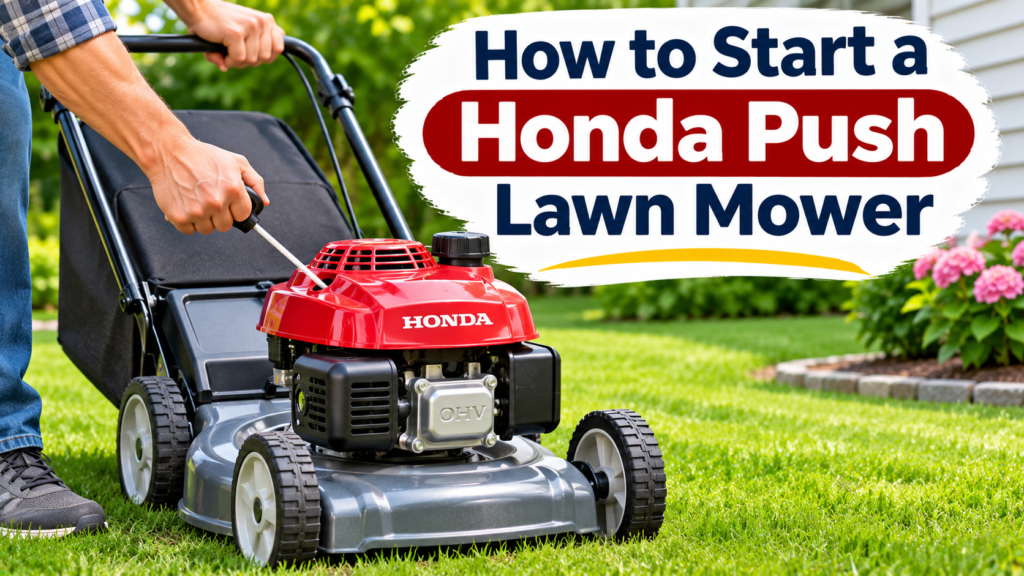
Most Honda gas-powered push mowers with a recoil starter follow the same basic procedure, although the choke and blade-control arrangements vary by model.
Quick Starting Checklist
- Move the mower onto a level, clear outdoor surface.
- Check the engine oil and fuel levels.
- Confirm that the air filter and safety guards are installed correctly.
- Turn the fuel shutoff valve to ON, if equipped.
- Set the throttle to CHOKE for a cold engine if the mower has a manual choke. Auto Choke models normally require no adjustment.
- Release the self-propel drive control, if equipped.
- Pull and hold the blade-control or flywheel-brake lever against the handlebar on models that require it for starting.
- Pull the starter grip gently until resistance is felt, then pull briskly.
- Return the starter grip gently and keep the required control lever engaged while the engine runs.
The Honda HRN lawn mower owner’s manuals describe this basic sequence for common recoil-start models.
Important: On models with Honda’s Roto-Stop blade-stop system, engine starting and blade engagement use separate controls. Follow the specific owner’s manual rather than assuming that squeezing any blade lever will start the engine.
Starting Requirements by Model Type
| Honda Mower Type | Choke Operation | Starting Method |
| HRN216PKA | Automatic | Blade-control lever and pull cord |
| HRN216VKA | Automatic | Blade-control lever and pull cord |
| HRX217VKA | Automatic | Blade-control lever and pull cord |
| HRR216VKA | Automatic on applicable versions | Blade-control lever and pull cord |
| Older HRS216PDA/SDA | Manual choke | Choke, control lever, and pull cord |
| Certain older HRC216 models | Manual choke | Model-specific controls and pull cord |
| HRN216VLA | Automatic | Electric starter or pull cord |
| HRX217 with Roto-Stop | Varies by version | Separate engine-start and blade-engagement procedure |
| HRN-BV battery mower | No gasoline choke | Battery and push-button controls |
The model and serial number determine the correct instructions.
Key Takeaway: Most recoil-start Honda gas mowers use the fuel valve, safety lever, and starter rope. Check whether your particular mower has automatic choke, manual choke, electric start, or Roto-Stop.
Before Starting a Honda Push Lawn Mower
A few simple checks can prevent starting problems and reduce the risk of injury.
1. Move the Mower Outdoors
Never start or run a gasoline lawn mower inside a garage, shed, basement, or other enclosed space.
Honda gasoline engines produce carbon monoxide, a poisonous gas that can cause serious injury or death.
Opening a garage door does not make running a gasoline engine indoors safe.
Choose an outdoor location with adequate ventilation.
2. Place the Mower on Level Ground
Set the mower on stable, reasonably level ground.
Make sure the cutting deck is not sitting in tall, dense grass.
Honda recommends starting in a clear or previously mowed area where the blades can rotate freely.
Remove stones, sticks, toys, and other objects from the surrounding area.
3. Check the Engine Oil
Most Honda gasoline push mowers use four-stroke engines with a separate engine-oil system.
Before starting:
- Place the mower on level ground.
- Make sure the engine is stopped.
- Locate the oil filler cap and dipstick.
- Remove the dipstick according to the owner’s manual.
- Check the oil level.
- Add the recommended oil if necessary.
- Avoid overfilling.
- Reinstall the cap securely.
The correct oil grade and checking procedure depend on the engine.
Many Honda mower engines use SAE 10W-30 under common operating conditions, but always confirm the specification in the owner’s manual.
Never operate a newly assembled gas mower without checking whether engine oil has been added. Some mowers are shipped without oil.
4. Check the Gasoline Level
Remove the fuel cap only when the engine is off and cool.
Use fresh gasoline that meets Honda’s specifications.
Honda recommends regular unleaded gasoline with no more than 10% ethanol.
Do not use E85 or gasoline containing more than 10% ethanol.
The Honda lawn mower fuel recommendations explain that unsuitable or deteriorated fuel can cause starting and running problems.
Avoid overfilling the fuel tank.
Clean up spills before starting.
5. Inspect the Air Filter
Make sure the air filter is properly installed and not excessively dirty.
A severely clogged filter may restrict airflow and cause poor engine performance.
Do not operate the mower with its air filter removed.
6. Check the Safety Controls
Inspect the control levers and cables.
The blade-control or flywheel-brake lever must operate properly.
Do not tie the lever to the handlebar or bypass safety interlocks.
Keep children, pets, and other people away from the mowing area.
Key Takeaway: Before starting, check oil, fresh gasoline, airflow, safety controls, and the surrounding area. Proper preparation helps prevent both starting problems and injuries.
Step-by-Step: How to Start a Honda Push Lawn Mower With Auto Choke
Many Honda HRN216 and HRX217 models use an automatic choke.
These mowers do not require the operator to manually close the choke before starting.
The following steps apply to common recoil-start models such as the HRN216PKA, HRN216VKA, and HRX217VKA.
Step 1: Position the Mower
Place the mower outdoors on a stable, reasonably level surface.
Keep the cutting deck away from tall grass and obstacles.
Stand behind the handlebar.
Step 2: Check Fuel and Oil
Confirm that the engine contains the proper amount of oil.
Check that the fuel tank contains fresh gasoline.
Make sure the fuel cap and oil cap are securely installed.
Step 3: Turn the Fuel Valve ON
Locate the fuel shutoff valve near the engine’s fuel system.
Move it to the ON position.
The valve allows gasoline to flow from the fuel tank toward the carburetor.
If the valve remains OFF, the engine may not start or may stop after using the remaining fuel in the carburetor.
Not every Honda model has an identical valve location, so refer to the owner’s manual if you cannot identify it.
Step 4: Release the Self-Propel Control
If the mower includes Honda Smart Drive or another self-propel system, leave that control disengaged.
This prevents the mower from moving forward unexpectedly when the engine starts.
A basic push mower without self-propulsion does not require this step.
Step 5: Hold the Blade-Control Lever
Pull the blade-control lever back against the handlebar.
Keep holding it.
On common flywheel-brake models, this lever releases the engine brake and allows the engine to run.
If you release it, the engine stops.
The blade begins rotating when the engine starts on these models. Keep hands and feet away from the cutting deck.
Step 6: Pull the Starter Rope
Grip the recoil starter handle.
Pull gently until you feel resistance.
Then pull briskly and smoothly.
Allow the starter grip to return gently.
Do not let the rope snap back against the engine.
Repeat if necessary, but stop and investigate if the rope becomes unusually hard to pull or kicks back.
Step 7: Let the Engine Run
Once the engine starts, continue holding the required blade-control lever.
The automatic choke system adjusts the starting mixture without manual intervention.
Honda advises allowing certain Auto Choke models to run for at least three minutes after a cold start before shutting them down to support easier restarting.
This period may be longer in cooler temperatures.
Step 8: Begin Mowing
Once the engine runs smoothly:
- Confirm the mowing area is clear.
- Check that the cutting height is appropriate.
- Push the mower forward.
- If equipped with Smart Drive, engage it gradually.
Avoid accelerating the mower into thick grass immediately after starting.
Key Takeaway: Auto Choke Honda mowers generally require no manual choke or priming. Turn the fuel valve ON, hold the required control lever, and pull the starter grip.
How to Start an Older Honda Push Mower With a Manual Choke
Certain older Honda HRS, HRR, HRC, and HRX models have manually operated throttle and choke controls.
The starting procedure differs from Auto Choke models.
Step 1: Turn the Fuel Valve ON
Find the fuel shutoff valve.
Move it to ON.
Confirm that the tank contains fresh gasoline.
Step 2: Set the Choke for a Cold Engine
If the engine has not been running and is cold, move the throttle lever to CHOKE.
This enriches the fuel-air mixture to help the engine start.
If the engine is already warm, move the throttle lever to FAST instead, where directed by the model’s manual.
Do not assume every Honda mower uses the same choke arrangement.
Step 3: Release the Drive Clutch
If the mower is self-propelled, disengage the drive clutch.
This prevents unexpected movement during starting.
Step 4: Engage the Required Safety Lever
Pull the flywheel-brake or blade-control lever against the handlebar on models that require it.
Continue holding the lever while starting.
Step 5: Pull the Recoil Starter
Pull the starter grip slowly until resistance is felt.
Then pull briskly.
Let the rope return gently.
Repeat only as necessary.
Step 6: Adjust the Choke After Starting
Once the engine starts and begins running smoothly, move the throttle away from CHOKE toward FAST as the engine warms.
Leaving a manual choke engaged unnecessarily may cause rough running, black exhaust smoke, or stalling.
Step 7: Start Mowing
Use the recommended operating throttle setting.
Honda commonly recommends FAST for effective mowing performance on models with a manual throttle.
The Honda HRS lawn mower manuals contain model-specific choke and starter instructions.
Key Takeaway: Older manual-choke Honda mowers generally need CHOKE when cold and FAST when warm. Auto Choke models do not require this adjustment.
How to Start a Honda Push Mower With Electric Start
Some Honda gasoline mowers include an electric starter.
Examples include certain HRN216VLA and HRX217 electric-start configurations.
These models still use gasoline and engine oil.
The electric starter replaces the need to pull the recoil rope during normal starting.
Electric-Start Procedure
- Move the mower outdoors onto level ground.
- Check the gasoline and oil.
- Turn the fuel valve ON.
- Release the drive-control lever.
- Hold the required blade-control lever against the handlebar, where applicable.
- Turn the starter key or operate the electric-start control as instructed.
- Release the starter control when the engine starts.
- Continue holding any required engine-control lever.
For certain Honda HRN216VLA models, the owner’s manual instructs operators not to operate the starter motor for more than approximately five seconds at a time.
If the engine fails to start, release the starter control and wait approximately ten seconds before trying again.
Follow the specific manual for your machine.
What if the Electric Starter Does Not Work?
Possible causes include:
- Discharged starter battery
- Incorrect control position
- Poor electrical connection
- Defective starter switch
- Starter-system malfunction
- Mechanical engine resistance
Some Honda electric-start gas mowers also have a recoil starter.
If the owner’s manual permits it, you may use the recoil starter when the electric-start battery is discharged.
However, do not attempt to force-start an engine with severe resistance or suspected mechanical damage.
Is Electric Start the Same as a Battery-Powered Mower?
No.
A gasoline mower with electric start uses a small battery to crank its gasoline engine.
A battery-powered mower uses an electric motor to rotate the cutting blades and does not use gasoline.
Key Takeaway: Electric-start gas mowers still require the correct fuel and safety-control positions. The key or starter switch replaces the normal pull-rope operation.
How to Start a Honda Push Mower With Roto-Stop
Some Honda models have a Roto-Stop blade-stop system.
This feature allows the engine to continue running while the cutting blades are stopped.
It is different from the flywheel-brake arrangement used on many standard push mowers.
How Roto-Stop Changes Starting
On a typical flywheel-brake mower, releasing the blade-control lever stops both the engine and the blade.
On a Roto-Stop model, engine operation and blade engagement are controlled separately.
For certain Honda HRX217 HYA and HZA models:
- Turn the fuel valve ON.
- Set the throttle to the position specified for starting.
- Release the drive clutch.
- Start the engine using the appropriate starter.
- Engage the cutting blades separately using the Roto-Stop controls when ready to mow.
The exact blade-control arrangement depends on the model.
Some versions use a yellow safety button and a separate blade-control lever.
Why Does This Matter?
If you follow instructions for the wrong control system, you may be unable to start the engine or may accidentally engage the blades.
Never bypass a blade-control mechanism.
Use the Honda HRX owner’s manual directory to identify the instructions for your particular mower and serial number.
Key Takeaway: Roto-Stop models have separate blade-engagement controls. Use the correct engine-start procedure before engaging the cutting blades.
How to Start a Battery-Powered Honda Push Lawn Mower
Honda also offers battery-powered walk-behind lawn mowers, including the HRN-BV series.
These do not have a gasoline engine, fuel valve, spark plug, or recoil starter.
Basic Battery-Mower Starting Procedure
- Place the mower in a clear outdoor area.
- Confirm the battery pack is adequately charged.
- Insert the battery fully into the battery compartment.
- Close the battery cover as instructed.
- Release the self-propel drive control.
- Operate the blade-control button and lever in the sequence specified by the owner’s manual.
- Start mowing once the motor and blades are running.
Some Honda battery models require the start or blade-control button to be pressed and held while the blade-control lever is engaged.
The control sequence varies by model.
Consult the Honda HRN battery mower manuals before operating one.
What if a Honda Battery Mower Does Not Start?
Check whether:
- The battery is charged.
- The battery is fully inserted.
- The battery contacts are clean and undamaged.
- The correct start-button sequence is being used.
- The blade-control lever is properly engaged.
- The battery temperature is within the permitted operating range.
Remove the battery before investigating a blocked blade or performing maintenance.
Key Takeaway: Battery-powered Honda mowers use battery and button controls instead of gasoline-engine starting steps. Do not apply fuel or choke instructions to battery models.
How to Start a Honda Lawn Mower When the Engine Is Cold
A cold engine may need different starting conditions than a warm engine.
The correct method depends on whether the mower has an automatic or manual choke.
Cold Starting With Auto Choke
For many newer Honda gas mowers:
- Check fuel and oil.
- Turn the fuel valve ON.
- Disengage the drive control.
- Hold the required engine-control lever.
- Pull the recoil starter.
The automatic choke handles the fuel-mixture adjustment.
Do not manually interfere with the choke mechanism.
Cold Starting With Manual Choke
For older models:
- Turn the fuel valve ON.
- Move the throttle to CHOKE.
- Disengage the drive clutch.
- Hold the required safety lever.
- Pull the starter rope.
- Move toward FAST after the engine starts and warms enough to run smoothly.
Should You Prime the Engine?
Only if your mower is actually equipped with a primer bulb and its owner’s manual instructs you to use it.
Many Honda Auto Choke mowers have no primer bulb and do not need manual priming.
Do not repeatedly press unfamiliar buttons on the engine.
Why Does Cold Starting Take Longer?
Cold temperatures can affect gasoline vaporization, engine friction, and starting characteristics.
A properly functioning choke system compensates for these conditions.
However, difficulty starting should not be ignored if it becomes frequent.
Key Takeaway: Auto Choke models start without manual adjustment. Older manual-choke models generally require CHOKE for a cold engine.
How to Start a Honda Push Lawn Mower After Winter Storage
A mower that has been unused for several months may require extra inspection before starting.
Stale gasoline is a common cause of problems after storage.
Step 1: Inspect the Mower
Look for:
- Fuel leaks
- Loose parts
- Damaged cables
- Corrosion
- Rodent damage
- Blocked air-filter housing
- Cracked fuel lines
Repair unsafe conditions before operation.
Step 2: Check the Engine Oil
Check the oil level and condition.
Change the oil when required by the manufacturer’s maintenance schedule.
Step 3: Check the Fuel
Gasoline left untreated for an extended period can deteriorate.
Honda warns that stale gasoline may cause carburetor deposits and starting problems.
If the mower was stored with old fuel, follow the Honda manual’s fuel-system service or storage-return procedure.
Do not assume adding fresh gasoline to badly degraded fuel will solve the problem.
Step 4: Check the Air Filter
Rodents, debris, or dirt may block airflow during storage.
Inspect and service the filter according to the owner’s manual.
Step 5: Check the Spark Plug
Make sure the spark plug cap is properly attached.
If the mower still will not start, the plug may need inspection or replacement.
Allow the engine to cool and disconnect the spark plug cap before maintenance.
Step 6: Start the Engine Normally
Use the correct procedure for the model.
Do not continuously yank the starter rope if the engine refuses to start.
Step 7: Let the Engine Stabilize
Once running, listen for abnormal sounds.
Stop the engine if it produces unusual knocking, excessive smoke, or strong fuel odors.
Honda’s Long-Term Fuel Storage Guidance
Honda recommends special fuel-system preparation when a gasoline mower will remain unused for more than approximately 30 days.
For longer seasonal storage, Honda advises removing gasoline from the fuel system according to the owner’s manual.
See Honda’s fuel-storage recommendations for the appropriate procedure.
Key Takeaway: After winter storage, inspect the mower, check fuel and oil, and follow the normal starting sequence. Stale fuel is an important possible cause of no-start conditions.
Why Won’t My Honda Push Lawn Mower Start?
If a Honda lawn mower does not start, begin with simple checks before attempting repairs.
Common Starting Problems
| Problem | Possible Cause | First Step |
| Engine does not start at all | Fuel valve OFF | Turn valve ON |
| Engine will not start | Empty fuel tank | Add fresh approved gasoline |
| Engine cranks but will not fire | Stale fuel | Follow fuel-system service instructions |
| Starter pulls but engine will not run | Blade-control lever not engaged | Hold the required lever |
| Cold engine will not start | Manual choke set incorrectly | Use CHOKE if required |
| Warm engine will not restart | Incorrect choke setting | Follow warm-start instructions |
| Engine starts and stops immediately | Control lever released | Maintain proper lever position |
| Engine runs rough | Dirty air filter or fuel problem | Inspect filter and fuel |
| Engine does not start | Spark plug cap disconnected | Inspect connection with engine stopped |
| Pull cord is unusually hard to pull | Obstruction or mechanical problem | Stop and investigate safely |
| Starter rope kicks back violently | Possible engine defect or recalled mower | Stop using and check recall status |
| Electric starter does not turn engine | Weak battery or electrical problem | Follow model-specific checks |
The exact diagnosis depends on the mower.
1. Fuel Valve Is Turned OFF
A closed fuel valve is one of the simplest causes of a no-start condition.
Locate the valve and turn it ON.
2. Gasoline Is Stale
Fuel that has remained in the system for months may deteriorate.
The mower may crank without starting or start briefly and stop.
Follow Honda’s fuel-system cleaning and storage guidance.
3. Blade-Control Lever Is Not Engaged
On flywheel-brake models, the engine cannot continue running unless the required lever is held against the handlebar.
Check the operator controls before investigating the carburetor.
4. Choke Is Set Incorrectly
On a manual-choke mower, a cold engine may need CHOKE.
A warm engine may need FAST.
On an Auto Choke mower, no manual setting is normally required.
5. Air Filter Is Dirty
A severely restricted air filter may affect the fuel-air mixture.
Inspect the filter and replace or clean it as specified by the manual.
6. Spark Plug Is Loose or Worn
A loose spark plug cap or damaged plug may prevent ignition.
With the engine stopped and cool, inspect the visible connection.
If the plug requires servicing, follow the owner’s manual or consult a qualified technician.
7. Carburetor Is Clogged
Fuel-system deposits may restrict gasoline flow.
If the mower has stale fuel and basic checks do not resolve the problem, carburetor service may be required.
Avoid dismantling unfamiliar fuel-system components near ignition sources.
8. The Blade or Engine Is Obstructed
If the starter rope is difficult to pull, do not force it.
Stop the engine-starting attempt.
Disconnect the spark plug cap before inspecting for debris, and never reach beneath the deck while the blade can start or move.
Follow the manufacturer’s safe tilting instructions.
9. The Mower May Be Affected by a Safety Recall
Certain Honda HRN216 and HRX217 lawn mowers were recalled because a camshaft decompressor defect can cause unusually high resistance or recoil-starter kickback.
The U.S. Consumer Product Safety Commission announced the recall on September 14, 2023, with an additional expansion on May 2, 2024.
If the starter rope kicks back violently or becomes abnormally difficult to pull, stop using the mower and check its model and serial number before trying again.
See Honda’s official recalls and updates page.
Key Takeaway: Check fuel, choke, safety controls, and airflow first. Stop immediately if the starter rope shows abnormal resistance or violent kickback.
Why Does My Honda Lawn Mower Start and Then Die?
A mower that starts but quickly stops may have a control, fuel, or airflow problem.
Blade-Control Lever Released
On many Honda mowers, releasing the blade-control lever stops the engine.
This is normal safety behavior.
Keep holding the lever while the mower runs.
Fuel Valve Partially Closed
If the valve is closed, the engine may run briefly using the gasoline already in the carburetor.
Check the valve position.
Stale or Contaminated Fuel
Gasoline containing water or excessive deposits can cause unstable engine operation.
Use only fuel that meets Honda’s requirements.
Manual Choke Left Engaged
An older mower may run poorly if the manual choke remains in the cold-start position after the engine warms.
Move the throttle according to the owner’s manual.
Automatic Choke Problem
If an Auto Choke mower repeatedly starts and stops despite proper fuel and controls, the choke system may require inspection.
Do not force or modify the mechanism.
Clogged Air Filter
Restricted airflow can contribute to poor running and stalling.
Service the filter correctly.
Heavy Grass Load
If the engine stalls only when entering thick grass, the cutting deck may be overloaded.
Raise the cutting height and reduce the mowing speed.
Do not put your hands near the blade or attempt to clear the deck while the engine is running.
Key Takeaway: A mower that starts and dies may have a normal safety-control issue, a fuel problem, restricted airflow, or excessive cutting load.
How to Stop a Honda Push Lawn Mower Correctly
Stopping procedures depend on the model’s control system.
Standard Flywheel-Brake Models
For many common Honda recoil-start mowers:
- Release the self-propel drive control.
- Release the blade-control lever.
- Allow the engine and blade to stop completely.
- Turn the fuel valve OFF after mowing.
Honda instructions for HRN216 and HRX217 flywheel-brake models identify releasing the blade-control lever as the normal method of stopping the engine.
Manual-Throttle Models
Some older models require the throttle to be moved toward SLOW or STOP as described in the owner’s manual.
The operator may also need to release the flywheel-brake lever.
Roto-Stop Models
On models with a blade-stop system, releasing the blade-control lever stops the blade but may leave the engine running.
Use the engine-stop procedure specified in the manual.
After Stopping
Before cleaning or servicing:
- Wait for all moving parts to stop.
- Allow hot components to cool.
- Turn the fuel valve OFF.
- Disconnect the spark plug cap before performing applicable maintenance.
Never leave a running mower unattended.
Key Takeaway: Standard blade-brake mowers generally stop when the required control lever is released. Roto-Stop models may need a separate engine-stop action.
How to Keep a Honda Push Lawn Mower Starting Easily
Routine maintenance can prevent many common starting problems.
Use Fresh Gasoline
Avoid keeping fuel in the mower for extended periods without proper storage preparation.
Use gasoline containing no more than 10% ethanol.
Store fuel in an approved container.
Turn the Fuel Valve OFF After Mowing
Honda recommends closing the fuel valve when the mower is not in use.
This helps reduce unwanted fuel flow toward the carburetor.
Maintain the Engine Oil
Check the oil before operation.
Change it according to the maintenance schedule for your particular engine.
Avoid overfilling.
Keep the Air Filter Clean
Service the filter as recommended.
Mowing in dusty conditions may require more frequent attention.
Inspect the Spark Plug
A worn, fouled, or improperly connected spark plug can contribute to starting difficulty.
Replace it according to the applicable maintenance schedule.
Keep the Cutting Deck Clean
Grass buildup can interfere with mowing performance.
Stop the engine, disconnect the spark plug cap, and follow the manufacturer’s safe deck-cleaning instructions.
Never clean a running mower.
Store the Mower Properly
Keep the mower in a dry, protected location.
Follow Honda’s fuel-storage recommendations before long periods of inactivity.
Follow Model-Specific Maintenance Intervals
Honda provides separate instructions for different mower families and engine models.
The Honda lawn mower maintenance and support page includes guidance for oil changes, air filters, fuel systems, and blade maintenance.
Key Takeaway: Fresh gasoline, correct oil levels, clean filters, and proper storage habits help prevent many Honda lawn mower starting problems.
Common Mistakes When Starting a Honda Push Lawn Mower
1. Forgetting to Open the Fuel Valve
If the fuel valve is OFF, gasoline may not reach the carburetor.
Turn it ON before starting.
2. Forgetting the Blade-Control Lever
Many Honda gas mowers require the blade-control lever to be held against the handlebar.
Without it, the engine may not start.
3. Trying to Prime an Auto Choke Engine
Most Auto Choke models do not require manual priming.
Use the manufacturer’s normal starting procedure.
4. Using CHOKE on a Warm Engine
On manual-choke models, a warm engine may need FAST rather than CHOKE.
Check the manual.
5. Pulling the Starter Rope Incorrectly
Pull smoothly and briskly after feeling resistance.
Allow the rope to return gently.
Do not jerk the handle violently.
6. Forcing a Jammed Starter Rope
Unusual resistance may indicate a mechanical problem.
Stop and investigate safely rather than forcing the starter.
7. Using Old Gasoline
Stale fuel is a common cause of starting and running trouble.
Follow Honda’s storage recommendations.
8. Starting Without Checking Engine Oil
Low oil can damage an engine.
Always check the oil according to the owner’s manual.
9. Mixing Oil Into Gasoline
Most Honda gas push mowers use four-stroke engines with separate oil and gasoline systems.
Do not mix oil with gasoline unless the specific equipment manual explicitly requires it.
10. Starting the Mower Inside a Garage
Gasoline-engine exhaust contains deadly carbon monoxide.
Always operate outdoors.
11. Engaging Self-Propulsion During Starting
Leave the drive control disengaged to avoid unexpected forward movement.
12. Bypassing Safety Controls
Never tie down blade-control levers or disable engine-stop mechanisms.
13. Refueling a Hot Engine
Stop the engine and allow it to cool before adding gasoline.
Keep fuel away from ignition sources.
14. Using the Wrong Model Instructions
Honda mowers may have Auto Choke, manual choke, electric start, or Roto-Stop.
Identify the correct model before operating unfamiliar controls.
Key Takeaway: Most starting mistakes involve incorrect control positions, stale fuel, unsafe handling, or using instructions meant for a different mower model.
How to Find the Correct Honda Push Mower Starting Instructions
Honda uses different model numbers and serial-number ranges for its lawn mowers.
To find the correct manual, first identify the mower.
Step 1: Locate the Model Number
Look for the identification label on the mower deck or frame.
Common Honda model names include:
- HRN216
- HRX217
- HRR216
- HRS216
- HRC216
Additional letters identify the specific configuration.
For example, an HRN216VKA and an HRN216VLA may have different starting equipment.
Step 2: Check the Serial Number
The serial number helps identify the correct version of the owner’s manual.
This matters because controls and features may change between production versions.
Step 3: Download the Owner’s Manual
Use the official Honda lawn mower owner’s manual directory.
Select the mower family and model.
Match the manual to the serial-number range when necessary.
Step 4: Review Honda’s Operation Videos
Honda provides official operation videos for several HRN, HRX, and HRR mower configurations.
These videos demonstrate:
- Fuel-valve location
- Starting controls
- Engine startup
- Drive controls
- Blade-control operation
- Safe shutdown
Visit the Honda Power Equipment support videos.
Step 5: Check for Safety Recalls
If the mower is an HRN216 or HRX217, check whether its serial number is affected by the starter-kickback recall.
Not every mower within the broad listed model range is affected.
Use Honda’s official serial-number lookup for confirmation.
Key Takeaway: The model and serial number are the most reliable way to identify the correct starting method and check whether a safety recall applies.
Conclusion
Starting a Honda push lawn mower is usually straightforward once you understand its fuel valve, choke system, safety lever, and starter controls.
For common Honda gas-powered push mowers with Auto Choke, check the oil and gasoline, move the mower outdoors, turn the fuel valve ON, hold the required blade-control lever, and pull the recoil starter.
Older Honda models with a manual choke generally require the throttle to be set to CHOKE for a cold start and moved toward FAST as the engine warms.
Electric-start gas models use a key or starter control, while Roto-Stop and battery-powered mowers have their own operating procedures.
If the mower does not start, check the fuel valve, gasoline condition, safety controls, choke setting, air filter, and spark plug connection before considering more involved repairs.
Never continue pulling a starter cord that has unusual resistance or kicks back violently. Certain Honda HRN216 and HRX217 mowers were recalled for precisely this type of hazard.
For reliable performance, I recommend following the owner’s manual for the exact model, checking engine oil before every use, maintaining fresh gasoline, and preparing the fuel system correctly before long-term storage.
With the right starting procedure and basic maintenance, most common Honda push mower startup problems can be avoided.
FAQs About How to Start a Honda Push Lawn Mower
How do you start a Honda push lawn mower for the first time?
Place the mower outdoors on level ground and confirm that the engine contains the correct amount of oil and fresh gasoline. Turn the fuel valve ON, engage the required safety lever, and use the model’s recoil or electric starter. For a manual-choke mower, set CHOKE when starting cold. Always check the owner’s manual before the first start.
Do Honda push lawn mowers have a primer bulb?
Many Honda push mowers use an Auto Choke System and do not require a primer bulb. Some older or different engine configurations may have other starting controls. Do not attempt to prime a mower unless it has a primer and the owner’s manual instructs you to use it.
Why won’t my Honda lawn mower start after pulling the cord?
Common causes include a closed fuel valve, stale gasoline, an incorrectly positioned manual choke, a blade-control lever that is not engaged, or a spark plug problem. If the cord is unusually hard to pull or kicks back violently, stop and check for mechanical problems or an applicable safety recall.
How do you start a Honda lawn mower with Auto Choke?
Check the fuel and oil, turn the fuel valve ON, release the drive control, and hold the required blade-control lever against the handlebar. Pull the starter grip gently until resistance is felt, then pull briskly. The Auto Choke System adjusts the starting mixture without manual choke operation.
How do you start a Honda lawn mower when it is cold?
For Auto Choke models, follow the normal starting procedure. For older manual-choke models, move the throttle to CHOKE before starting a cold engine. Once the engine runs smoothly, adjust the throttle toward FAST according to the owner’s manual.
How do you start a Honda lawn mower after winter storage?
Inspect the mower for damage, check the engine oil, evaluate the gasoline, clean or inspect the air filter, and ensure the spark plug cap is connected. If old gasoline has deteriorated, follow Honda’s fuel-system service instructions before starting. Then use the normal starting sequence for the model.
Why does my Honda push mower start and then stop?
On many Honda models, releasing the blade-control lever automatically stops the engine. Other possible causes include a closed fuel valve, stale fuel, incorrect manual-choke operation, restricted airflow, or a fuel-system problem. Check the control positions first, then investigate fuel and maintenance issues.